Beyond the March: 5 Surprising Facts From India’s Republic Day Parade
Every year, the grand Republic Day parade unfolds on Kartavya Path, a familiar spectacle of military precision and vibrant cultural pride. But this polished ceremony is more than just an annual tradition; it is the biography of the Republic itself, written year after year in marching boots, roaring jets, and the diverse colours of its people. To trace its history is to uncover the story of a nation finding its footing, defining its identity, and announcing its presence to the world.
1. The Date Isn’t a Coincidence; It’s a Promise Fulfilled
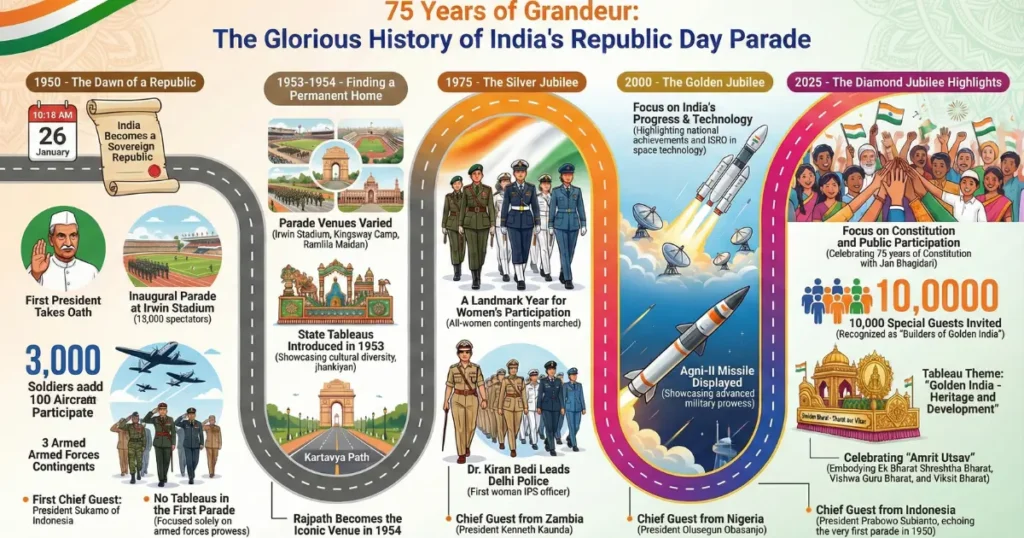
The choice of January 26th for Republic Day was a deeply symbolic act. While India achieved independence on August 15, 1947, its Constitution was formally adopted on January 26, 1950. This specific date was chosen to honor the declaration of “Purna Swaraj” (complete independence) made by the Indian National Congress two decades earlier, on January 26, 1930. For a new nation charting its own course after centuries of colonial rule, this connection was profoundly important. It anchored the modern, constitutional republic to the earliest promises of the freedom struggle, transforming an administrative date into a powerful fulfillment of a generational pledge.
RelatedPosts
2. The First Parade Was Radically Different
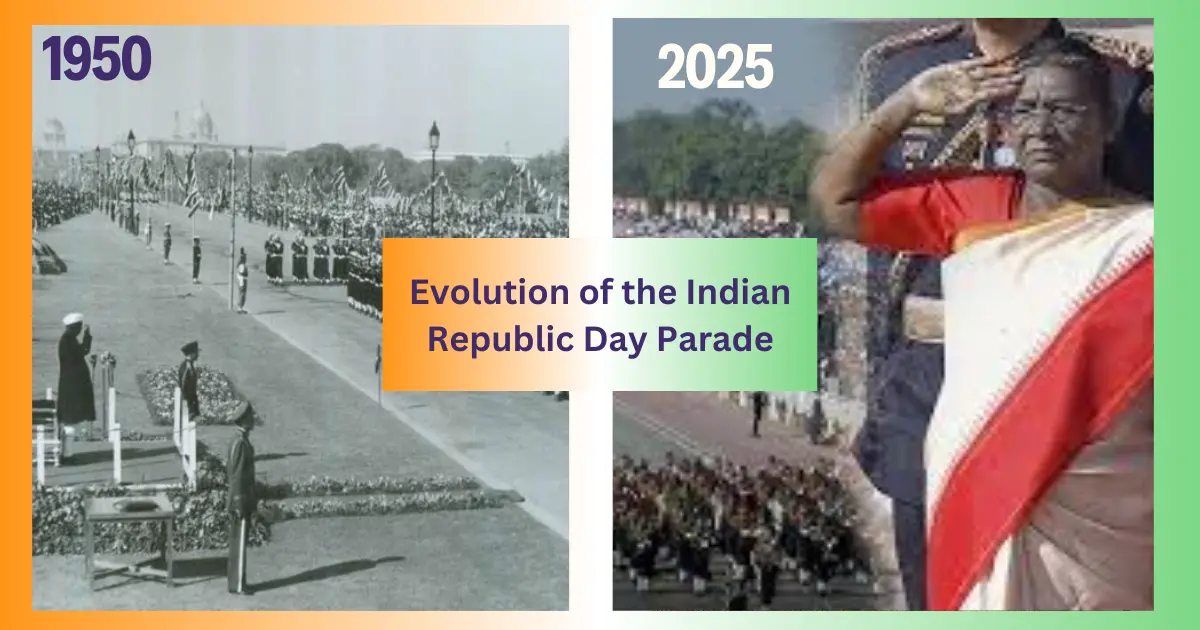
The inaugural Republic Day parade in 1950 was a world away from the event we see now. Held in the afternoon, it was a more modest but profoundly significant affair that established many traditions while differing in key ways:
- Venue: It was not held on Grand Central Avenue but at the Irwin Stadium, now known as the Major Dhyan Chand National Stadium.
- Time: The parade commenced at 2:30 PM, with President Dr Rajendra Prasad arriving to take the salute before a crowd of 15,000.
- Composition: The procession featured 3,000 soldiers and 100 aircraft, including Dakotas and Spitfires, but did not include any cultural jhankis (tableaux). It also began with a thundering 31-gun salute, a number that was later standardized to the 21-gun salute known today.
This first parade also established the tradition of inviting a foreign head of state as the chief guest, with President Sukarno of Indonesia being the first to receive the honor. Though smaller, this military-focused event was a powerful symbol of a new beginning for the nation.
3. The Iconic Avenue Wasn’t the Original Stage
For its first few years, the Republic Day parade did not have a permanent home. Between 1950 and 1954, the event was held at various locations across Delhi, including Irwin Stadium, Kingsway Camp, and even the Ramlila Maidan. The parade found its permanent and iconic home on Rajpath (now known as Kartavya Path) in 1954.
Just as the parade’s location evolved, so too did its very composition. A year earlier, in 1953, the iconic cultural jhankis from different states were introduced. This addition was designed to foster a spirit of unity and healthy competition, transforming the event into a celebration of the nation’s diverse cultural fabric.
4. 1975: A Landmark Year for Women in the Parade
The 1975 parade, marking the Republic’s Silver Jubilee, was a watershed moment for women’s participation. It took place against the challenging national backdrop of the Emergency, a period when democratic rights were curtailed. In this complex moment, the parade projected a powerful and progressive vision through two historic firsts:
* For the first time, all-women contingents from the Army, Navy, and Air Force marched on the Rajpath, showcasing their growing role in the armed forces.
* Dr. Kiran Bedi, India’s first female IPS officer, made history at the age of 26 by leading the Delhi Police contingent.
The legacy of 1975 was carried forward by other trailblazing officers in subsequent years, including Captain Divya Ajit, Lieutenant Commander Sandhya Chauhan, and Squadron Leader Sneha Shekhawat, who would go on to lead their respective all-women contingents. In the midst of political turmoil, the 1975 parade’s powerful showcase of women’s leadership made an undeniable statement about empowerment and progress.
5. A Global Stage: The Power of the Chief Guest
The tradition of inviting a foreign head of state has transformed the Republic Day parade into a major diplomatic event. The presence of a chief guest is a high honor, signifying deep friendship and strategic partnership. Over the decades, the guest list has included some of the world’s most influential leaders, underscoring the parade’s global stature. Notable guests include:
- President Sukarno, Indonesia (1950)
- Nelson Mandela, President of South Africa (1995)
- Barack Obama, President of the United States (2015)
- The collective leaders of all ASEAN nations (2018)
- Emmanuel Macron, President of France (2024)
- President Prabowo Subianto, Indonesia (2025)
- Ursula von der Leyen; António Costa European Union (2026)
This unique tradition elevates the celebration from a purely national event to a powerful statement on the world stage, reflecting India’s foreign policy priorities and its evolving place in the global community.
A Parade That Reflects a Nation
The Republic Day parade is far more than a static ritual; it is a living chronicle that has consistently evolved to mirror India’s journey. From a fledgling military display at a stadium to a global spectacle of cultural diversity, technological might, and diplomatic outreach, its story is India’s story. Each year, as the contingents march and the tableaux roll down Kartavya Path, they don’t just celebrate the Republic’s past—they write the next chapter of its ever-unfolding narrative.
(Disclaimer: This text is based on general beliefs and material available on the internet. publicreact.com does not confirm it.)
Note: If you find any errors in the above article or have some suggestions to improve the article, please tell us through comments or email, and we will adopt your suggestions on priority. Thank you!