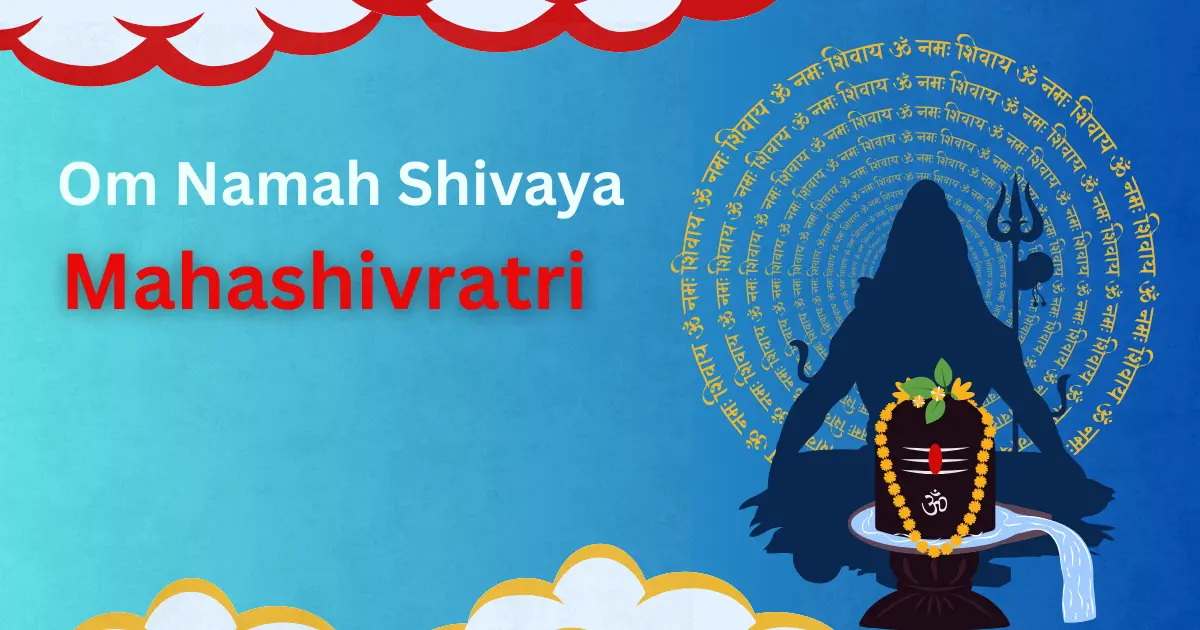
Mahashivratri is one of the most sacred and significant festivals in Hindu tradition, celebrated with profound devotion across India and by millions of Hindus worldwide. This holy night is far more than a religious celebration – it is a spiritual awakening that calls devotees to inner transformation, self-discipline, and divine connection with Lord Shiva. The word Mahashivratri literally means “the great night of Shiva,” representing a moment when cosmic energies align to support meditation, prayer, and spiritual growth.
In 2026, Mahashivratri falls on Sunday, February 15th, marking a special occasion when devotees will observe fasting, perform night-long worship, and seek the blessings of Lord Shiva. This sacred night symbolizes the triumph of consciousness over ignorance, light over darkness, and good over evil. Whether you are a seasoned devotee or someone seeking spiritual guidance, Maha shivratri offers a powerful opportunity to connect with your inner self and experience the divine presence of Shiva within.
Table of Contents
Mahashivratri 2026: Exact Dates and Sacred Timings
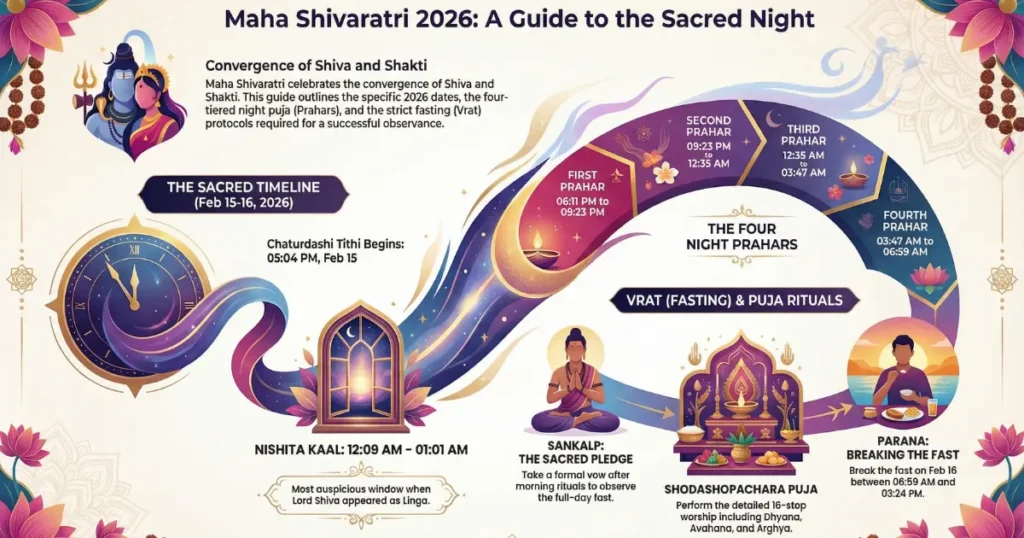
Understanding the precise timing of Mahashivratri is essential for performing rituals at the most auspicious moments. According to the Hindu lunar calendar, here are the exact timings for 2026:
Mahashivratri Date: Sunday, February 15, 2026
Chaturdashi Tithi (Sacred 14th Lunar Day):
- Begins: 5:04 PM on February 15, 2026
- Ends: 5:34 PM on February 16, 2026
Nishita Kaal (Most Auspicious Puja Time):
- Begins: 12:09 AM on February 16, 2026
- Ends: 1:01 AM on February 16, 2026
- Duration: Approximately 52 minutes
This midnight window is considered the most spiritually potent time, when Lord Shiva is believed to have manifested as the infinite Lingam. Performing rituals, chanting mantras, or meditating during Nishita Kaal is said to yield maximum spiritual benefits and blessings.
Parana Time (Fast Breaking):
- Begins: 6:59 AM on February 16, 2026
- Ends: 3:24 PM on February 16, 2026
Breaking your fast (parana) within this time window ensures you receive the full spiritual benefits of your Mahashivratri vrat (fast).
The Four Prahars: Structure of Night-Long Worship
Mahashivratri night is traditionally divided into four equal periods called Prahars, each with its own spiritual significance and worship rituals. This ancient system allows devotees to honor Lord Shiva throughout the entire night with focused devotion.
First Prahar (Evening Prayer):
- Time: 6:11 PM to 9:23 PM (February 15)
- Focus: Purification and Preparation
- This period represents the purification of the body and mind. Devotees take ritual baths, light lamps in temples and homes, and prepare their sacred space for worship. The first Prahar sets the intention for the entire night of devotion.
Second Prahar (Night Prayer):
- Time: 9:23 PM to 12:35 AM (February 16)
- Focus: Surrender and Meditation
- During this period, devotees engage in deeper meditation and chanting. The recitation of mantras like “Om Namah Shivaya” and sacred hymns like the Shiva Chalisa fills the air with spiritual vibrations, creating an atmosphere conducive to inner transformation.
Third Prahar (Nishita Kaal – Midnight Prayer):
- Time: 12:35 AM to 3:47 AM (February 16)
- Focus: Direct Communion with Shiva
- This is the most sacred period of the night. The Nishita Kaal (12:09 AM to 1:01 AM) falls within this Prahar and is considered the ideal time for performing Rudrabhishek (ritual bathing of the Shiva Lingam) and deep meditation. Spiritual energy is at its peak during this time.
Fourth Prahar (Pre-Dawn Prayer):
- Time: 3:47 AM to 6:59 AM (February 16)
- Focus: Renewal and Gratitude
- As dawn approaches, the final Prahar represents spiritual renewal and awakening. Devotees continue their prayers with increased intensity, preparing for the conclusion of their night-long vigil and the breaking of their fast.
The Mythology and Spiritual Significance of Mahashivratri
Mahashivratri holds multiple layers of spiritual meaning, rooted in ancient Hindu mythology and philosophy. Understanding these stories deepens our appreciation for this sacred festival.
The Divine Marriage of Shiva and Parvati:
According to the most popular legend, Maha Shivratri commemorates the celestial wedding of Lord Shiva and Goddess Parvati. After Parvati’s intense meditation and devotion, Lord Shiva agreed to marry her. This union represents the perfect balance of masculine (Shiva – consciousness, stillness) and feminine (Parvati – energy, movement) forces. Their marriage is not merely a romantic event but a cosmic principle – the convergence of consciousness and creative energy that sustains the universe.
The Emergence of the Lingam:
Another significant narrative describes how Maha Shivratri marks the night when Lord Shiva manifested himself as an infinite column of light – the Shiva Lingam – in response to the competition between Brahma and Vishnu over supremacy. This representation symbolizes the formless, transcendent nature of Shiva and his role as the ultimate source of all existence.
The Night of Cosmic Dissolution:
Some traditions view Mahashivratri as the night when Lord Shiva performs his cosmic dance (Tandava), which represents the continuous cycle of creation, preservation, and dissolution. This dance symbolizes the dynamic, ever-changing nature of the universe and Shiva’s role as both destroyer and regenerator.
These mythological narratives collectively teach that Mahashivratri celebrates not just historical or legendary events, but universal principles of balance, transformation, and spiritual awakening.
Mahashivratri Fasting and Worship: Rituals and Practices
Observing Mahashivratri involves more than just abstaining from food – it is a comprehensive spiritual practice aimed at purifying the body, mind, and soul. Let us understand the key rituals and practices:
Fasting (Vrat):
- Begin your fast from sunrise on February 15, 2026
- Observe either a full fast (Nirjala – without water) or partial fast consuming only fruits, milk, and sattvic foods
- Avoid grains, salt, onions, and garlic, as these are considered stimulating and distract the mind
- The fast should be observed with the intention of self-discipline and devotion, not as mere dietary restriction
Bathing and Purification:
- Take a ritual bath in the evening before beginning worship
- Some devotees take multiple baths throughout the night, particularly during Nishita Kaal
- The act of bathing symbolizes washing away impurities and ego
Shiva Puja (Worship):
- Offer bilva (Aegle marmelos) leaves to the Shiva Lingam – these leaves are sacred and believed to please Shiva
- Perform Rudrabhishek – ritual bathing of the Lingam with milk, yogurt, honey, clarified butter (ghee), and water
- This five-fold offering symbolizes purification and nourishment
- Light oil lamps in the temple or home to dispel darkness and ignorance
- Circumambulate the Lingam while chanting sacred mantras
Night-Long Vigil (Jagaran):
- Remain awake throughout the night, engaged in meditation, prayer, or seva (service)
- Stay in the temple or create a sacred space at home where you can maintain focus on Shiva worship
- This practice demonstrates commitment and allows for sustained spiritual practice
Breaking the Fast (Parana):
- After sunrise on February 16, complete your morning rituals
- Break your fast between 6:59 AM and 3:24 PM
- First, consume fruits or sattvic foods, then gradually transition to regular meals
- Break your fast only after completing your worship and seeking Shiva’s blessings
The Power of “Om Namah Shivaya” Mantra on Mahashivratri
Mahashivratri is the ideal occasion to harness the transformative power of “Om Namah Shivaya,” the most sacred mantra dedicated to Lord Shiva. This ancient mantra holds profound spiritual significance and offers multiple layers of meaning:
The Meaning:
- “Om” – the primordial sound representing the universe and divine consciousness
- “Namah” – I bow, I honor, I salute
- “Shivaya” – to Shiva, the supreme consciousness
- Together: “I bow to the supreme consciousness that is Shiva”
Spiritual Benefits of Chanting “Om Namah Shivaya”:
- Mental Peace: Regular chanting calms the mind, reducing anxiety and stress
- Spiritual Awakening: The vibration of this mantra activates dormant spiritual energy within
- Karmic Purification: Continuous repetition is believed to cleanse past karmic imprints
- Divine Connection: The mantra creates a direct link between your consciousness and Shiva’s infinite power
- Self-Realization: Through sustained practice, devotees experience the non-dual reality that Shiva represents
How to Practice on Mahashivratri:
- Chant “Om Namah Shivaya” 108 times using a mala (sacred beads) during each Prahar
- According to tradition, repeating this mantra 108 times once removes the sins of one lifetime
- Maintain a steady, rhythmic pace, allowing the sound vibrations to resonate through your body
- Combine chanting with meditation, visualizing divine light and Shiva’s presence
- The peak benefit comes during Nishita Kaal when cosmic energies are most aligned
Mahashivratri’s Social and Cultural Impact
Mahashivratri transcends individual spiritual practice – it is a celebration that brings communities together and reinforces the cultural fabric of Hindu civilization. Across India and globally, this festival demonstrates the universal appeal of Shiva worship and the timeless relevance of its teachings.
Community Gathering and Service:
On Mahashivratri, temples overflow with devotees from all walks of life. Rich and poor, educated and uneducated, young and old – all stand together before the altar of Shiva, united in devotion. Temples distribute free meals (prasad) to thousands of visitors, embodying the principle of service and equality.
Sacred Processions and Festivities:
Major pilgrimage centers like Varanasi, Haridwar, and Ujjain witness millions of devotees. The night is filled with devotional songs, traditional music, and dance forms that have been passed down through generations. These cultural expressions keep ancient traditions alive while making them accessible to contemporary practitioners.
Personal Transformation and Social Harmony:
The values emphasized during Mahashivratri – self-discipline, meditation, non-attachment, and devotion – contribute to building a more conscious and harmonious society. When millions of people practice these virtues simultaneously, it creates a positive collective energy that benefits not only individuals but the entire world.
Mahashivratri Wishes, Blessings, and Spiritual Messages
Heartfelt Wishes for Mahashivratri
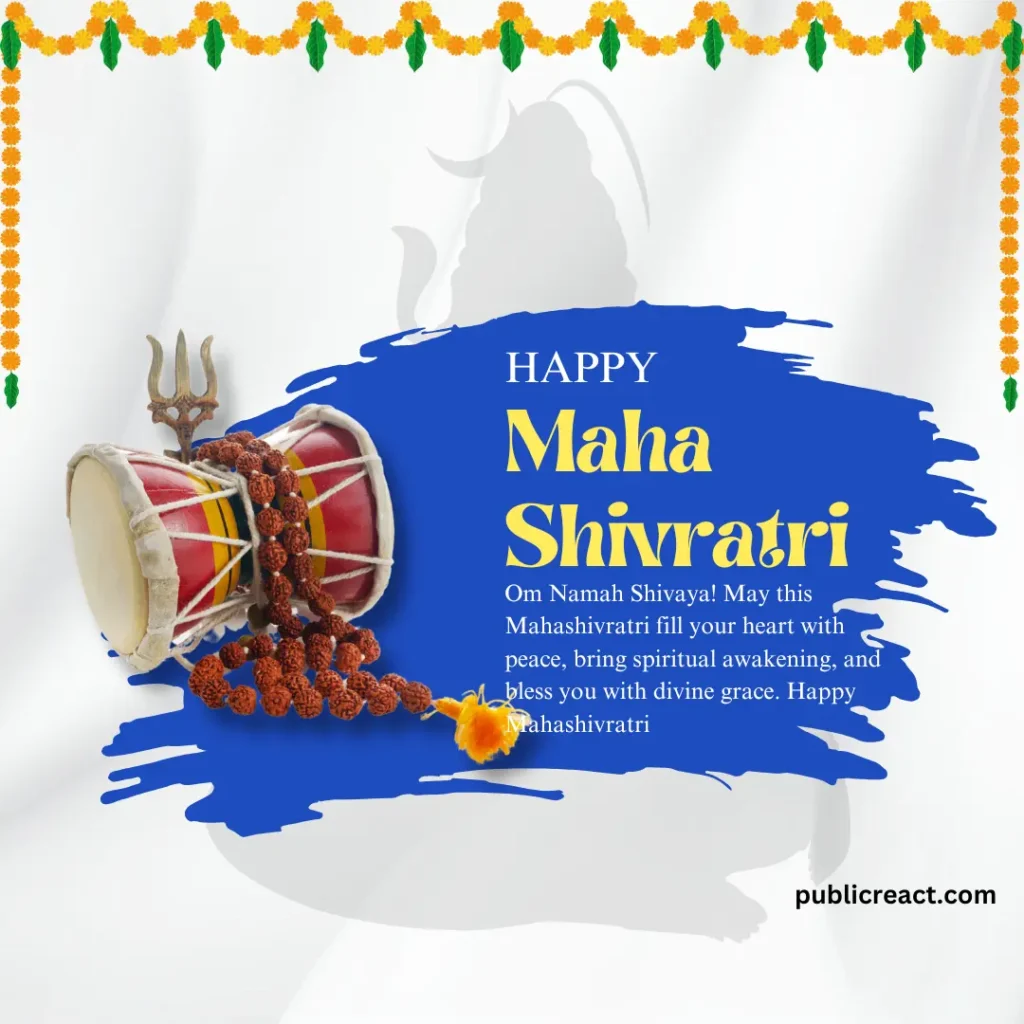
- “Om Namah Shivaya! May this Mahashivratri fill your heart with peace, bring spiritual awakening, and bless you with divine grace. Happy Mahashivratri!”
- “May Lord Shiva’s blessings illuminate your path and guide you toward inner enlightenment this Mahashivratri.”
- “On this sacred night of Mahashivratri, may you experience the divine presence of Shiva within your soul and find eternal peace.”
- “Wishing you a spiritually enriching Mahashivratri filled with meditation, devotion, and the grace of Mahadev.”
- “May the divine energy of Lord Shiva purify your mind, strengthen your spirit, and lead you to self-realization. Happy Mahashivratri!”
- “As you observe the Mahashivratri fast, may it cleanse your karma and bring you closer to spiritual liberation.”
- “May this Mahashivratri night awaken the divine Shiva consciousness within you and grant you inner strength and wisdom.”
- “Celebrating Mahashivratri – the sacred convergence of Shiva and Shakti – wishing you blessings of love, light, and eternal peace.”
- “Om Namah Shivaya! May Mahashivratri bring harmony to your life and elevate your spiritual consciousness.”
- “On this holy night of Mahashivratri, may Lord Shiva’s grace shower upon you and your loved ones with prosperity and well-being.”
Mahashivratri Wishes
- “Wishing you a Mahashivratri filled with mindfulness, meditation, and the profound peace that comes from connecting with Shiva.”
- “May the chanting of sacred mantras on Mahashivratri dissolve your ego and align you with the universe’s divine purpose.”
- “Happy Mahashivratri! May you experience the transformative power of this sacred night and discover your true spiritual nature.”
- “As the midnight hour approaches on Mahashivratri, may your prayers reach the infinite consciousness of Lord Shiva.”
- “Wishing you courage, wisdom, and spiritual awakening on this blessed night of Mahashivratri.”
- “May the festival of Mahashivratri inspire you to live with greater purpose, compassion, and devotion.”
- “Om Namah Shivaya! This Mahashivratri, may you find the strength to overcome obstacles and achieve inner peace.”
- “On Mahashivratri, may the cosmic dance of Shiva inspire you to embrace change and transformation in your life.”
- “Celebrating the divine union of Shiva and Parvati – wishing you Mahashivratri blessings of love and spiritual growth.”
Mahashivratri wishes in English
- “May this Mahashivratri night bring clarity to your mind, purity to your heart, and awakening to your soul.”
- “Wishing you a Mahashivratri filled with the blessings of Lord Shiva and the grace to follow the righteous path.”
- “Happy Mahashivratri! May the sacred energy of this night transform your consciousness and elevate your spiritual journey.”
- “As you fast and meditate on Mahashivratri, may you shed your karmic burdens and embrace spiritual freedom.”
- “May Lord Shiva’s blessings protect you from negativity and guide you toward enlightenment this Mahashivratri.”
- “Wishing you a Mahashivratri where meditation becomes effortless, mantras become melodious, and Shiva’s presence becomes palpable.”
- “Om Namah Shivaya! May this Mahashivratri night mark the beginning of your spiritual transformation and inner awakening.”
- “On this sacred Mahashivratri, may you experience the bliss of union with the divine and the peace of self-realization.”
- “Happy Mahashivratri! May your devotion on this holy night create ripples of positive energy in the universe.”
- “May this Mahashivratri bring harmony between your mind, body, and spirit, creating a foundation for lasting peace.”
- “Wishing you Mahashivratri blessings that fill your life with spiritual purpose, divine love, and eternal bliss.”
Shiv Mantra in English
Panchakshari Shiv Mantra –
[Om Namah Shivaya]
Maha Mrityunjaya Mantra –
[Om Tryambakam Yajaamahe Sugandhim Pushtivardhanam |
Urvaarukamiva Bandhanaan-Mrityormuksheeya Maamritaat ||]
Shiv Aarti in English
Om Jai Shiv Omkara, Swami Jai Shiv Omkara।
Brahma Vishnu Sadashiv, Ardhangi Dhara॥
Om Jai Shiv Omkara॥
Ekanan Chaturanan Panchanan Raje।
Hansasan Garudasan Vrishvahan Saje॥
Om Jai Shiv Omkara॥
Do Bhuj Chaar Chaturbhuj Dashbhuj Ati Sohe।
Trigun Roop Nirakhate Tribhuvan Jan Mohe॥
Om Jai Shiv Omkara॥
Akshmala Vanmala Mundmala Dhari।
Tripurari Kansari Kar Mala Dhari॥
Om Jai Shiv Omkara॥
Shvetambar Pitambar Baghambar Ange।
Sankadik Garunadik Bhootadik Sange॥
Om Jai Shiv Omkara॥
Kar Ke Madhya Kamandalu Chakra Trishuldhari।
Sukhkari Dukhhari Jagpalan Kari॥
Om Jai Shiv Omkara॥
Brahma Vishnu Sadashiv Janat Aviveka।
Pranavakshar Ke Madhye Yeh Teeno Eka॥
Om Jai Shiv Omkara॥
TrigunswamiJi Ki Aarti, Jo Koi Nar Gaave।
Kahat Shivanand Swami, Manvanchit Phal Paave॥
Om Jai Shiv Omkara॥
Om Jai Shiv Omkara, Swami Jai Shiv Omkara।
Brahma Vishnu Sadashiv, Ardhangi Dhara॥
Om Jai Shiv Omkara॥
Frequently Asked Questions About Mahashivratri
Question 1: What is the exact date of Mahashivratri in 2026, and why is it celebrated on this date?
Answer: Mahashivratri in 2026 will be celebrated on Sunday, February 15, 2026. However, it is important to note that the Chaturdashi Tithi (the 14th lunar day) – which defines Mahashivratri – begins at 5:04 PM on February 15 and extends until 5:34 PM on February 16. According to Hindu tradition, Mahashivratri is celebrated on the Chaturdashi Tithi of the Krishna Paksha (waning moon phase) in the month of Phalguna (February-March).
This date is significant because it marks the night when Lord Shiva was born and, according to popular belief, when he married Goddess Parvati. The date changes every year because the Hindu calendar is lunar-based, but it always falls on the Chaturdashi Tithi of Phalguna, which typically occurs in February or early March.
Question 2: What is Nishita Kaal, and why is it the most important time for Mahashivratri worship?
Answer: Nishita Kaal refers to the midnight period, specifically the most sacred hour during Mahashivratri night. In 2026, Nishita Kaal for Mahashivratri is from 12:09 AM to 1:01 AM on February 16. This time window is considered the most spiritually potent moment of the entire night. According to Hindu philosophy and mythology, it is believed that Lord Shiva manifested as the infinite Lingam (cosmic pillar of light) during this midnight hour.
Devotees believe that prayers, meditations, and rituals performed during Nishita Kaal have maximum efficacy and can grant liberation (moksha). This is why observant Shiva devotees ensure they perform Rudrabhishek (ritual bathing of the Lingam) and chant mantras during this sacred window.
Question 3: What are the rules for fasting on Mahashivratri, and who should observe this fast?
Answer: Mahashivratri fasting is based on self-discipline and spiritual intention rather than rigid rules. Generally, devotees observe one of three types of fasts: (1) Nirjala Vrat – complete fast without food or water, (2) Phalahar Vrat – consuming only fruits and milk, or (3) Partial Vrat – avoiding grains, salt, onions, and garlic but consuming sattvic (pure) foods. The fast begins at sunrise on February 15 and is broken between 6:59 AM and 3:24 PM on February 16, after completing morning rituals and Shiva worship. However, fasting is not mandatory for everyone.
Pregnant women, young children, the elderly, and those with health conditions should consult with a physician or spiritual guide before fasting. The intention and devotion matter more than the strict adherence to fasting rules. Many people observe Mahashivratri by staying awake, meditating, and worshipping instead of fasting.
Question 4: How should devotees break their fast after observing Mahashivratri Vrat?
Answer: Breaking the fast (parana) is as important as observing the fast itself. Devotees should break their fast between 6:59 AM and 3:24 PM on
February 16, 2026. The traditional and recommended approach is:
- (1) After completing morning rituals and worship, consume light foods like fruits, milk, or sattvic sweets first.
- (2) Wait 15-20 minutes before consuming cooked foods.
- (3) Gradually introduce whole grains, vegetables, and other regular foods.
- (4) Always break the fast with a sense of gratitude and with the blessings of Lord Shiva.
Breaking the fast abruptly with heavy or spicy foods can cause digestive discomfort. Additionally, some traditions suggest that breaking the fast within the Chaturdashi Tithi (before 5:34 PM on February 16) provides maximum spiritual benefit.
Question 5: Can women and children participate in Mahashivratri celebrations and fasting?
Answer: Absolutely. Women, men, and children of all ages can participate in Mahashivratri celebrations and worship. However, the intensity and type of practice should be adjusted based on age, health, and capacity.
For Children: Children can participate in simplified forms of worship, chanting mantras, and spending time in temples. Very young children need not fast; they can join in singing devotional songs and learning about Lord Shiva.
For Women: Women at all stages of life – whether menstruating, pregnant, or post-menopausal – can worship Lord Shiva and observe Mahashivratri according to their capacity. Traditional beliefs that restrict women during menstruation are being increasingly recognized as outdated by modern spiritual leaders and scholars.
For Elderly: Older devotees can observe Mahashivratri according to their health condition, perhaps with lighter fasts or by focusing on meditation and prayer rather than strict fasting.
Universal Accessibility: The core message of Mahashivratri – devotion, self-discipline, and inner awakening – is universal and accessible to all, regardless of gender, age, or social status. Every sincere effort to connect with the divine, within one’s capacity, is honored by Lord Shiva.
Embracing Mahashivratri’s Transformative Power
Maha Shivratri on February 15, 2026, offers you a precious opportunity to pause the endless rush of daily life and reconnect with your deepest spiritual essence. This sacred night is not merely a ritual to be observed but an invitation to profound inner transformation. As you fast, meditate, and chant mantras throughout the night, you are participating in an ancient tradition that has sustained the spiritual consciousness of millions across centuries.
The beauty of Maha shivratri lies in its universality. Whether you observe the complete four-Prahar worship schedule, meditate during the sacred Nishita Kaal, or simply spend a few minutes in silent communion with Lord Shiva, your sincere effort is honored. The festival teaches us that spirituality is not about perfection but about intention, consistency, and the willingness to evolve.
As you approach this Mahashivratri, we invite you to consider: What aspects of your life require transformation? What negative patterns do you wish to release? What spiritual heights do you aspire to reach? Use this sacred night as a mirror to reflect on your journey and as a catalyst for positive change.
We would love to hear from you. How do you plan to celebrate Mahashivratri in 2026? What does Lord Shiva’s teachings mean to you? What spiritual experiences have you had during previous Mahashivratri celebrations? Share your stories, insights, and reflections in the comments section below. Your personal experiences can inspire others on their spiritual journey.
Additionally, please share this comprehensive guide with your friends, family, and spiritual community. When more people understand the true significance of Mahashivratri and approach it with genuine devotion, the collective spiritual energy benefits society as a whole. Together, we can create a wave of positive consciousness that touches every corner of our world.
Om Namah Shivaya! Wishing you a deeply meaningful and transformative Mahashivratri on February 15, 2026!
(Disclaimer: This text is based on general beliefs and material available on the internet. publicreact.com does not confirm it.)
Note: If you find any errors in the above article or have some suggestions to improve the article, please tell us through comments or email, and we will adopt your suggestions on priority. Thank you!